Hair care
Going natural: how to transition from relaxed hair
Whether you cut it all off tomorrow or grow it out over a year, going natural is a choice about how you want to care for your hair. There's no wrong pace.
The short answer
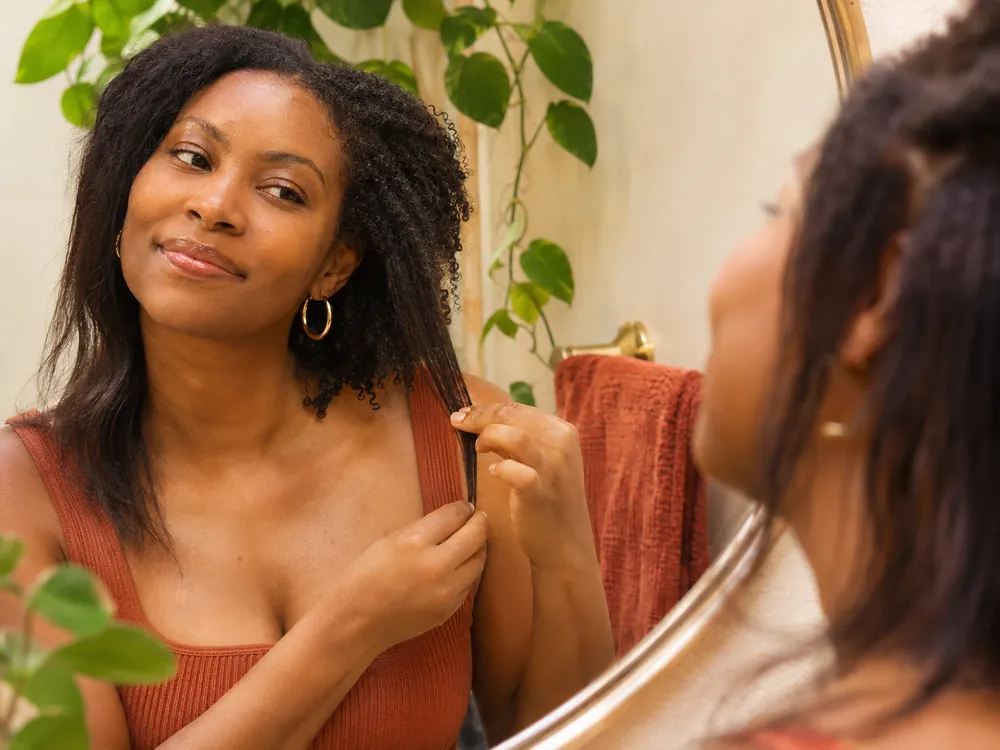
You can big chop (cut off the relaxed ends at once) or transition (let natural hair grow in and trim the relaxed ends gradually). If you transition, handle the point where the two textures meet very gently, keep heat low, use blending styles, and trim regularly.
Two paths
The big chop
Cut away all the relaxed hair at once. You start fresh with one texture, which makes your routine simpler right away. It's a big visual change, and many people love it.
The long-term transition
Grow your natural hair in while trimming the relaxed ends a little at a time. You keep length, but you're caring for two textures for months.
Neither is "more natural". Choose the one that fits your patience, your job, your budget and how you feel looking in the mirror.
The fragile spot: where two textures meet
The point where your new growth meets the relaxed hair (often called the line of demarcation) is where breakage tends to happen. The textures behave differently, and the join takes the stress every time you comb.
- Detangle only with conditioner in, in small sections, from the ends up.
- Hold the hair above the join while you work on tangles below it.
- Keep heat to a minimum. Straightening to "blend" the textures can damage your new growth.
- Trim relaxed ends regularly, every couple of months, so they don't drag on the new hair.
Styles that blend two textures
- Twist-outs and braid-outs: set on damp hair, they give both textures the same pattern.
- Flexi-rod or perm-rod sets: curl the relaxed ends to match your roots.
- Low buns and puffs: easy, as long as you skip the tight elastic and hard brushing at the edges.
- Braids or twists with added hair: can give you a break, but only if they're installed with low tension. See protective styles.
What to expect
Hair grows roughly half an inch a month, so give yourself time. In the first months, you'll learn how your natural texture behaves: how it drinks up conditioner, how it shrinks as it dries, how long a twist-out lasts. That knowledge is the real reward.
Shrinkage is normal. Coily hair can look far shorter than it really is. Stretch a curl gently and you'll see your true length.
Be kind to yourself
Some days the two textures will frustrate you. That's not a sign you're doing it wrong. Keep a photo log once a month. Progress is easier to see in pictures than in the mirror.
What you'll need
As an Amazon Associate we earn from qualifying purchases. Links go to Amazon search results so you can compare options and prices. We haven't tested these specific products; choose by the description and your own needs.
Hair shears
For trimming relaxed ends. Use real hair shears, not kitchen scissors.
See options on AmazonMoisturizing deep conditioner
Helps both textures feel softer and detangle more easily.
See options on AmazonSources & further reading
This guide is general education based on the dermatologist resources above. It isn't a diagnosis or treatment plan and hasn't been independently clinically reviewed. Follow your clinician's instructions over any routine here.